Dina, the leatherback sea turtle, died on Christmas Day, 2024, in the waters off Sydney.
She spent August in the Gulf of St. Lawrence eating jellyfish. When she tried to head south in September, she was stopped by the Canso Causeway. She tried nine times to leave the area, heading up along the western coast of Cape Breton, but always turned back. It is quite likely that she encountered cold water coming down from the Labrador current, which would have deterred her from keeping on. By the time she made it around Cape Breton, it was too late. Department of Fisheries and Oceans scientists had been tracking her movements and discussing how to help her. Ultimately, a rescue mission was called off “to let nature take its course.”
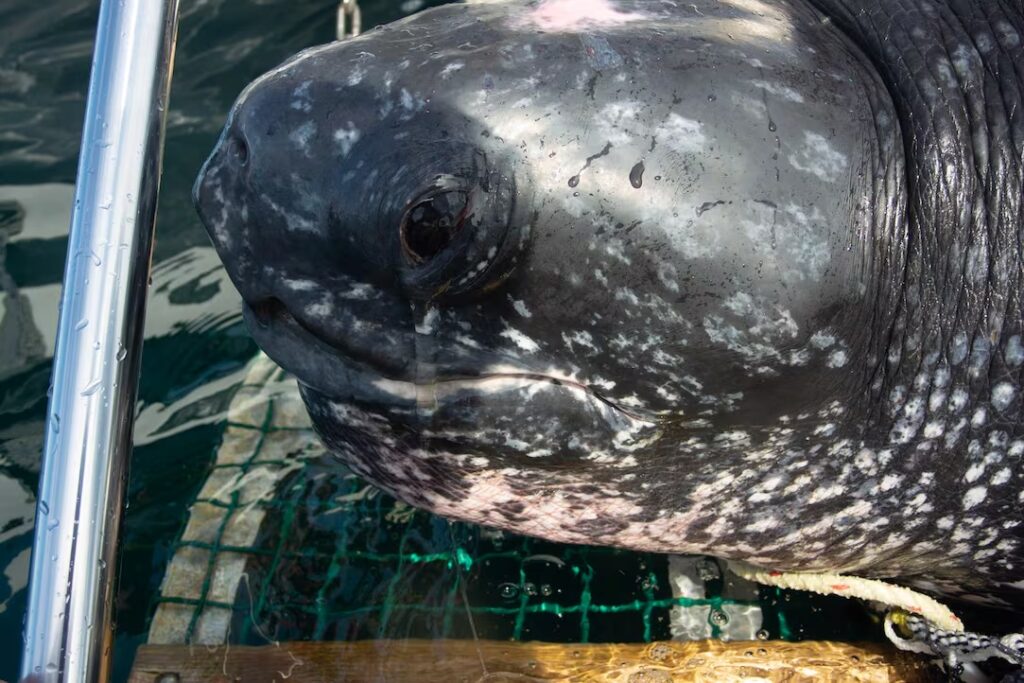
When asked about this, DFO said in an email, “Each incident is assessed on a case-by-case basis, with decisions guided by factors such as logistical feasibility, resource availability, weather and safety considerations, and the likelihood of a successful outcome. In this case, the turtle’s condition, including if it was healthy enough to survive being captured at sea and relocated, was unknown when a decision had to be made. There is not one individual solely responsible for the decision-making process. Given the low likelihood of success, the Department decided to suspend the proposed response. The decision was taken following discussions amongst DFO staff and partners, and after all the information was provided for consideration.”
Leatherback sea turtles have been listed as an endangered species under the Species at Risk Act (SARA) since 2003. The Government of Canada has an action plan for its recovery, and it falls to the Minister of Fisheries and Oceans and, therefore, DFO, to implement the recovery strategy. Under the action plan, the goal “is to increase the population such that the long-term viability of the leatherback sea turtles frequenting Canadian waters is achieved.” As such, a number of recovery objectives were identified: understanding human threats, understanding life history, habitat identification and protection, risk reduction, education, and international initiatives.
When asked what DFO was doing to understand the impact of the Canso Causeway, a human built barrier, on leatherback sea turtles, they said, “DFO has an established understanding of the potential impacts of causeways on fish and fish habitat, including fish passage. With respect to Leatherback Sea Turtles, DFO continues to undertake tagging studies to understand their movements and use of habitat in Canadian waters. In light of this existing knowledge, and ongoing studies by DFO, the Department is not currently proposing to request additional studies related to the Canso Causeway at this time.”
The Access to Information and Privacy (ATIP) document on Dina, indicated the desire of staff for action to be taken in aid of her and to tackle the challenge the Canso Causeway poses to leatherback sea turtles. Two DFO scientists had an email exchange in December 2024 that seemed to indicate the importance of gathering more data. Heidi Schaefer spoke about how important it was to get an idea of the scope of the problem using eDNA (environmental DNA). She said, “We need to find some way to document and demonstrate the issue of the barrier to migration/death trap. If a few tagged animals isn’t enough [...] and if LBTs (leatherback turtles) washing up dead on beaches isn’t enough, maybe this would be a way to show the magnitude of the issue?”
In response, Katherine Hastings thought this was a good idea that was worth exploring, for she added, “In short, FFHPP (Fish and Fish Habitat Protection Program) has indicated that documentation of the causeway as an issue is required to move further with broader conversations.”
Section 2 of the recovery action plan is entitled Critical Habitat. SARA defines habitat for aquatic species as "... food supply, migration and any other areas on which aquatic species depend directly or indirectly in order to carry out their life processes, or areas where aquatic species formerly occurred..."
Leatherback turtles use the Strait of Canso for a migration path. When asked if the Strait of Canso has been evaluated as critical habitat, DFO replied, “Critical habitat will be identified, to the extent possible and based on the best available information, in an amended recovery strategy currently in development. Targeted consultation and engagement will occur with First Nations, other Indigenous organizations, and stakeholders in advance of the publication of the amended recovery strategy on the Species at Risk public registry for a 60-day public comment period.”
They anticipate initiating consultation on the amended recovery strategy in mid-2027.
DFO put out a document entitled The management of existing facilities and structures under the Fisheries Act and the Species at Risk Act. Its purpose is to outline how DFO applies fish and fish habitat protection under the Fisheries Act and SARA to facilities, “including a facility or structure that was constructed prior to the enactment of these provisions.”
Facilities that are in water ways must be in compliance with these acts. This means that facilities or structures could not cause the death of fish, could not cause harmful alteration, disruption, or destruction of fish habitat, and could not impact aquatic species at risk, their critical habitat, or residence.
DFO has to authorize any structure that will kill or harm fish or species at risk. Under the Fisheries Act, fish refers to any aquatic animal.
This would mean that, unless authorized, the Canso Causeway is out of compliance with the Fisheries Act and SARA.
But it turns out, because it was built in 1955, and the Fisheries Act was implemented in 1979, and the prohibitions under SARA not until 2004, DFO said, “As a result impacts associated with the construction of the causeway are outside of the scope of these provisions.
The Position Statement clarifies that these provisions would, however, apply to any new undertaking or activity associated with the causeway. Should the proponent propose modifications, maintenance, or decommissioning of the causeway, these activities would need to comply with relevant legislation.”
As revealed in the ATIP, DFO scientist Wendy Williams noted in an email on December 19, 2024, that the causeway and canal do not meet current Fisheries Acts standards. And though they were built before the Act, she said, “DFO has developed and is implementing an existing facilities position statement that requires existing structures to comply with the Act. DFO is currently apply this statement to other existing facilities/structures, including hydroelectric facilities and the Avon River causeway.”
Recent news informs us that the canal needs major renovations. Prior to receiving that news, DFO said that for the Fisheries Act to be triggered, “New undertakings or activities resulting in the substantial reconstruction or expansion of the causeway, which would alter fish passage, would trigger compliance with the Fisheries Act and the Species at Risk Act. Maintenance of the existing causeway and its infrastructure does not alter fish passage and therefore does not trigger compliance with the legislation.”
The official answers from DFO aren’t good enough for Darren Porter, the fisherman who acquired the ATIP that detailed what happened to Dina. “That’s downright misleading and has no legal backbone in my opinion,” he said. In an earlier conversation, he said, “They manage fish fishers. The first purpose [of DFO and the Fisheries Act] is the management of fishers. Second, it is to protect fish and fish habitat. They do not enforce the protection of fish habitat. The proof is in the convictions. There's not a single conviction of a barrier in the history of Nova Scotia. Not one. They have beautiful laws, sections 34 and 35 of the Fisheries Act. The whole thing is a beautiful piece of legislation, but there's zero enforcement.”
“They do not need to wait until they touch the structure.” he said. “The structure does fall into the current Fisheries Act; it just simply needs to go to court for case law. If I had financial backing, I would take this to court tomorrow.”
He added the application of the Fisheries Act is biased. “I’m an old fisherman,” he said, “and the Act applies to me. And Indigenous people were here thousands of years before the Fisheries Act, and they can’t kill whatever they want, but yet these structures do.”
Dr. Mike Dadswell, Acadia University biology professor and former DFO biologist, said, “Gobbledygook, all words. They took out all the causeways in PEI that were put in before the Act. They finally took out the causeway at Moncton because the local DFO guy in Moncton lobbied them so hard. They’re dragging their feet on this.”
Dadswell studied the collapse of the lobster fishery that followed the completion of the Causeway. When the Canso Causeway was built, there were no environmental laws or reviews. As the repercussions of it began to be realized, there was talk about making away for wildlife to go through. “We were talking about it like crazy at the meetings back in ‘79 and ‘80,” said Dadswell, “but it became very obvious that the government didn't want to do it, and so DFO just swept it under the carpet as they do. If they can't come up with an easy solution. They let it die away.”
And they want it to die away now?
“Oh sure,” he said, “but now they really can't because for the first time, they've got something that's a law; you can't kill endangered species.”
By Beverley Phillips (originally published by the Inverness Oran June 24, 2026.)