A large mass lumbered up onto a beach in Trinidad in 2010.
It’s leatherback sea turtle nesting season, and on this night, this large female is joining the dozens of other turtles digging a nest to lay their clutch on the beach.
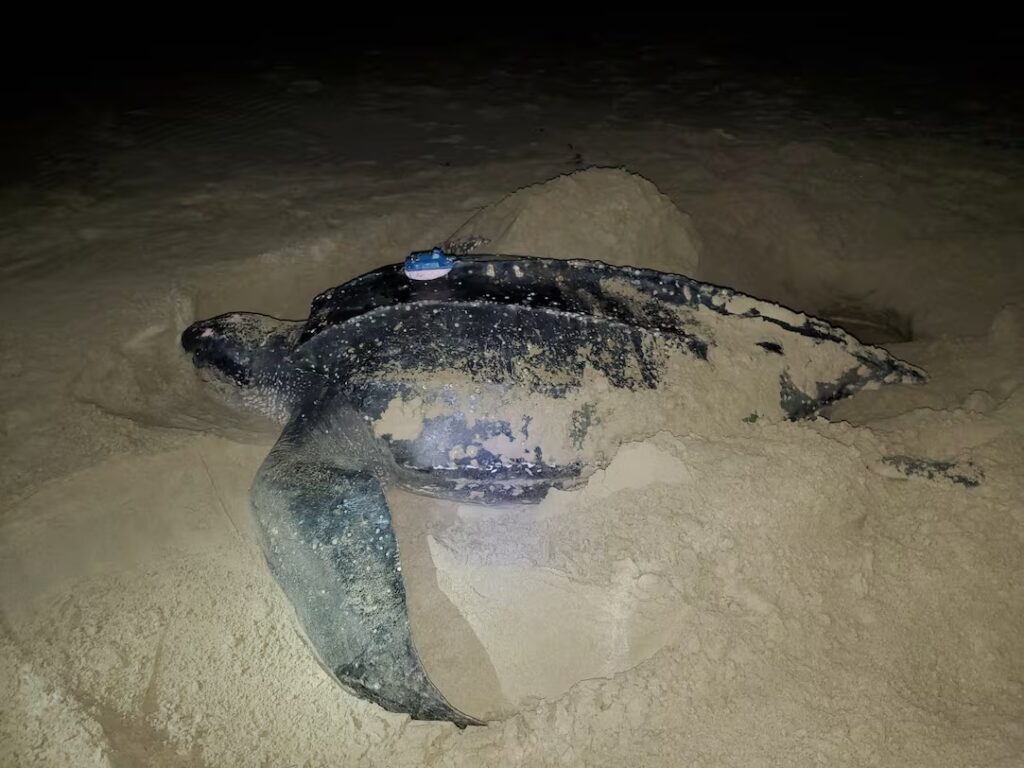
A beach patrol comes upon this new arrival. They check to see if she is tagged with either a flipper or a Passive Integrated Transponder (PIT). She isn’t, so they tag her, injecting a PIT into the muscle of her shoulder. This tag will allow her to be identified by future beach patrols or researchers who come across her. They take her measurements, such as her weight and the size of her carapace, and they assess her for injuries. As her data is entered into their database, she receives an alphanumeric label. But, in 14 years, she will come to be known as Dina (pronounced DEE-nah).
As the team watches her nest, they see her dig a nest in the sand with her hind flippers. Once it’s ready, she lays upwards of 100 eggs. Not all are viable. Some are considered to be filler or spacer eggs that may protect the viable ones. They do this by improving gas exchange within the nest, or by filling up a predator’s belly before it reaches the fertilized eggs.
When she finishes laying, she carefully covers the eggs back up in her efforts to protect them from those predators. And then it’s back to the ocean, a place where she is much more at ease with her thousand-pound body.
This is the first time she has been seen nesting. She may lay up to nine clutches, at eight to 12 day intervals during the nesting season. Nesting season runs from March 1st to August 31st, though it peaks in May and June.
Trinidad is home to the densest leatherback nesting population in the world. The small Caribbean island takes its status seriously. The main nesting beaches are prohibited areas and require special permission to enter. There are regulations in place to protect the well-being and habitat of the endangered species, and violations carry fines of $100,000 and 2 years in prison.
Dina’s eggs will hatch in about 60 days. As they lie in the ground incubating, they are vulnerable to predation by crabs, birds, and mammals, including humans, who illegally poach them. And while leatherback nesting beaches in Trinidad are protected, the species is found in both the Atlantic and the Pacific Oceans, and development and beach erosion are threats to that critical habitat.
After incubation, the hatchlings are just a few inches long. They emerge en masse, usually at night, and make a mad dash for the ocean. This moment, and the next few days, are dangerous for the tiny creatures. It’s estimated that only one in 1000 hatchlings will reach adulthood.
It’s still a mystery just where leatherback turtles go as they make their journey to adulthood. Scientists think that juveniles spend those years in the open ocean, drifting with the currents and eating jellyfish. At this stage of their life, plastic is a significant threat, as plastic bags look like their favourite food, and they can also get entangled in it.
If this were Dina’s first nest, she may have been about 15 years old, the average age when leatherbacks are thought to reach maturity. She will only breed every two or three years and will always return to the region, though not necessarily the same beach, where she was born to lay her eggs.
It’s interesting to note that once a male leatherback reaches the ocean, it never returns to land.
For some western Atlantic Ocean leatherback turtles, their journeys won’t take them too far. They may spend their days feeding around the Gulf of Mexico. Others head north, following seasonal prey. Some cross the ocean to the UK or Spain. Others, like Dina, come to Atlantic Canada and spend the summer keeping our jellyfish populations under control.
Atlantic Canada is an important sea turtle habitat. “We are a sea turtle country,” said Kathleen Martin, executive Director of the Canadian Sea Turtle Network. “We have identified more than 15 different countries as contributing to the population of leatherbacks off the coast of Atlantic Canada. We are like the UN of sea turtles up here. Everybody’s sea turtles are coming to Canadian waters to feed on our abundance of jellyfish. It’s an incredibly important place in the life history of leatherback sea turtles. It’s really one of the most important places that exists for them anywhere.”
At this stage of their lives, they have no natural predators. They have even been seen chasing sharks that tried to eat them. The main threats to them are related to human activity, including accidentally getting caught in fishing gear or ghost gear, pollution, coastal development, and climate change.
Because of the risk of fishing gear to sea turtles, Martin has developed relationships with fishers. “We work with fishermen to talk about disentangling sea turtles that they find caught in their fishing gear,” she said. “So how do you do that safely? How do you make sure the hooks are taken out of the turtles? How do we make sure that they’re safe in this region? Leatherbacks breathe air, so they can drown if they are not released soon enough.”
Martin lauds the work of the fishing community. “One of the many beautiful things about this [Atlantic Canada as sea turtle country] is the contribution commercial fishers have made to this work. More than anybody else, they care deeply about what goes on in the ocean. They’re really in tune with it. I just give them the information they need to do this safely, to understand the importance of it, and to empower them with all of the background information they might need. They have been amazing people on the water who say, ‘Hey, we are seeing this change’ or ‘This is something that is happening that we haven’t seen before.’ They’re scientists out there.”
And while fishing gear is a problem, the Canadian Sea Turtle Network has been able to work with fishers to minimize the threat of this problem in our region. Another threat to leatherback sea turtles in Atlantic Canada has recently come to light - the Canso Causeway. For leatherback turtles who have enjoyed eating jellyfish in the waters of the Gulf of St. Lawrence all summer long, the Strait of Canso is a natural and historic migration route for the long-lived species.
Fourteen years after being tagged on a beach in Trinidad, Dina was found by the Department of Fisheries and Oceans. DFO has been tagging and studying leatherback sea turtles for years. On August 19, 2024, Dina was captured by the DFO Sea Turtle Unit in the Gulf of St. Lawrence. They gave her their own tag to track her movements. The data her tag would send back to DFO would show her struggle to swim south because she would keep coming up to a blocked Strait of Canso.
By Beverley Phillips (originally published in the Inverness Oran June 3, 2026)