On August 19, 2024, the Department of Fisheries and Oceans' Sea Turtle Unit captured and tagged a large female leatherback sea turtle while working in the Gulf of St. Lawrence. She was named Dina.
DFO is interested in the turtle species, as in 2003, Canada listed it as an endangered species under the Species at Risk Act (SARA). Leatherbacks are the world’s largest turtle. They can be over 1000 pounds and almost nine feet long. They receive their name from their shell, which is leathery and not hard.
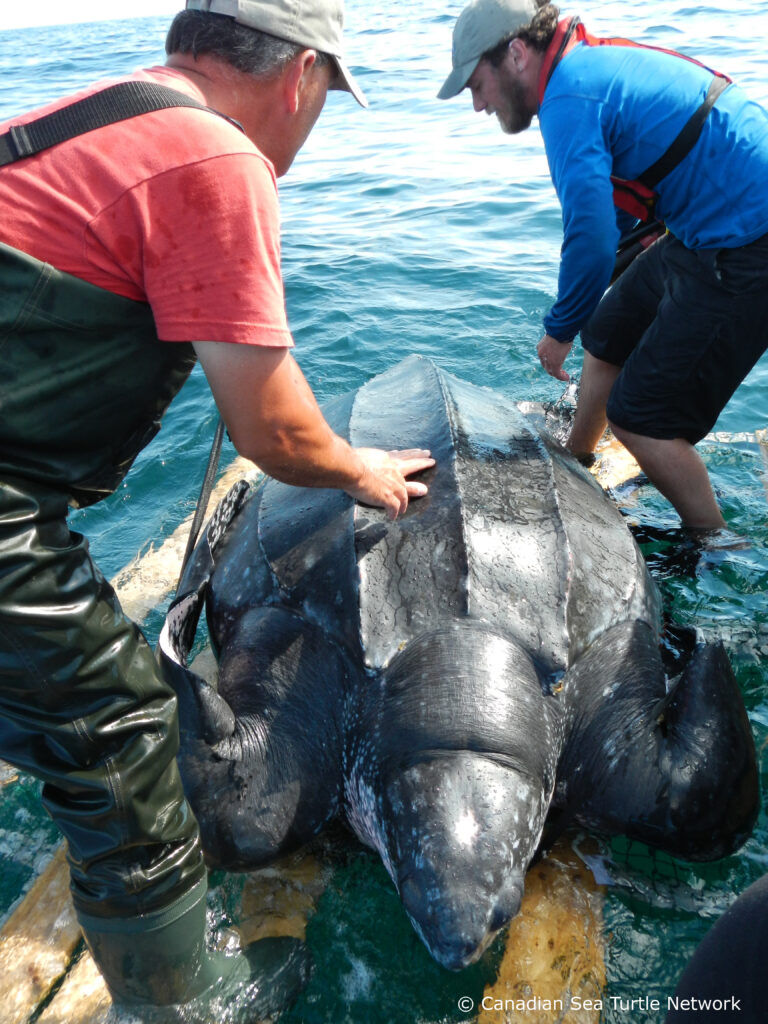
As the sea turtle unit examined Dina, they discovered that she was already micro-chipped. She was tagged in Trinidad in 2010, when she was found nesting at Grande Riviera Beach. Trinidad is a leatherback nesting hotspot, with roughly 20,000 nests each year. The Caribbean island has one of the longest-running programs of its kind in the Northwestern Atlantic Ocean, Nature Seekers, founded in 1990, which patrols and protects nesting sites. DFO has worked with them since 2012.
The details of Dina are known thanks to Darren Porter, a fisherman from the Annapolis Valley who requested an Access to Information and Privacy report to uncover her story.
On September 12, 2024, about three weeks after being tagged, signals from Dina’s tag indicated she had finished her Canadian visit for another year and was ready to head south, back to warmer waters before winter set in.
On September 16, she was in St. George’s Bay, the northern end of the Strait of Canso. Until 1954, the Strait of Canso would have been an important waterway for species of all kinds travelling between the Gulf of St. Lawrence and the open Atlantic Ocean.
Dina was monitored trying to leave the area nine times. It is theorized that the cooler surface waters north of St. George’s Bay deterred her from keeping around Cape Breton. Leatherback turtles have a strong instinct to head south, and it would not be in their nature to go from warmer to cooler waters.
On November 26, Claire Evers, a Species-At-Risk-Program biologist, emailed colleagues about a leatherback turtle that was still in the Gulf of St. Lawrence. She was concerned as it was very late in the season for her to be there, and the water was becoming cold. She wanted to discuss scenarios for her and what they could do.
Out of that meeting, three scenarios arose, each with its own challenges.
Scenario one: They intervene to get her out of the Gulf while she is still swimming. This would be challenging as in late November the weather is bad, and there were only two team members at that time of year. Also, leatherback turtles only spend 10 percent of their time at the surface. Finding her would be difficult.
Scenario two: She strands on a beach alive. That raises different challenges. They are very large animals. Proper equipment would be needed to safely move her, including an enclosed trailer to keep her warm. Her physical condition was unknown, and unlike other sea turtles, leatherback turtles are almost impossible to rehabilitate.
Mike James is a turtle biologist with DFO, and he understood the value of Dina. He described the Northwest Atlantic Ocean population of sea turtles as “really crashing,” and she was a known nester.
The team began organizing equipment and planning how to reach her in a timely manner, depending on where she was stranded. According to James, “Typically, they become hypothermic and strand. It can be several hours or days before they actually die.”
Scenario three: She strands on a beach, dead. That obviously creates a less urgent situation, but they would do a necropsy on her if they could.
The team concluded that the best hope was if she made it out of the Gulf of St. Lawrence on her own. “But,” they said, “we have never observed a tagged leatherback turtle remain in the Gulf this late in the season, and it is unknown what her lowest thermal tolerance will be.”
It is clear from the documents released that the staff were very concerned about the animal and wanted to help her.
Opening the canal in hopes that she would pass through was not an option, as the water was being drained from it for dredging and repair.
Her movement showed she wasn’t feeding much, and she was swimming tens of kilometres every day, moving between Nova Scotia, PEI, and New Brunswick waters.
On November 29th, James reported she was 20 km north of Tracadie Bay, PEI, moving west.
December 2nd, she pinged off the waters along Inverness County, well offshore from Cheticamp, to which James commented, “Unfortunately, she seems to get about this for, then turn south again. So close to freedom yet so far…”
On December 3rd, Branden LaPointe, noting the weather would be good for the next two days, said, “C&P (Conservation and Protection) is able and willing to deploy multiple vessels and contribute to planning and executing an at-sea intervention at this time.”
On December 9th, there was a meeting of the DFO Sea Turtle Unit and Conservation and Protection at which they discussed scenarios and made a checklist of equipment necessary for an at-sea rescue.
On December 10th, the Sea Turtle Unit sought permission from MAR Service Management to attempt a recovery operation.
The request was approved. They had secured three program vessels, two shore teams with trucks and trailers, a Canadian Coast Guard helicopter, and a PAL flight with appropriate staff. They planned to leave at daybreak on the 11th.
At 5:30 pm on the 10th, the operation was called off by the MAR chief of science, “as he/she wanted nature to take its course.”
On December 17th, Dina was against swimming south, along the west coast of Cape Breton. The water temperature was very cold, 0 to 3°C, and nothing above 6°C. With this news, James said, “At this point, I don’t think it’s likely she will exit the Gulf.”
On December 20th, she was off Cheticamp. Her movements matched the currents. She had entered cold-stunning, the late stage of hypothermia.
On December 23, Dina pinged off Sydney. She made it to the ocean. She is in waters 3 to 6°C. James wrote to Francine Desharnais, Regional Director of Science, Maritimes Region, “I am cautiously optimistic she may ultimately recover. Ambient ocean temperature plus movement and behavioural data collected [...] indicated she was both highly stressed and not likely foraging for many weeks while she navigated out of the southern Gulf of St. Lawrence, desperately searching for an exit south. We expect Dina was, therefore, likely severely emaciated. By the end of last week, Dina’s locomotion had slowed considerably, then appeared to stop. This was an expected progression. I anticipated hypothermia was a likely outcome.”
In an email shortly afterwards, he added that she is drifting into warmer water, which would hopefully revive her. “She is a huge animal, even in an emaciated state, she won’t warm quickly, which is actually a good thing under these circumstances.”
DFO staff were hopeful.
On December 25th, Christmas Day, the summary report on Dina states, “Dina was 205 km north of the Gulf Stream edge when her movements slowed again, and she began moving east-northeast. Using data collected by her satellite tag, DFO Sea Turtle Unit confirmed Dina was dead and floating at the surface.”
By Beverley Phillips (originally published by the Inverness Oran June 10, 2026)